
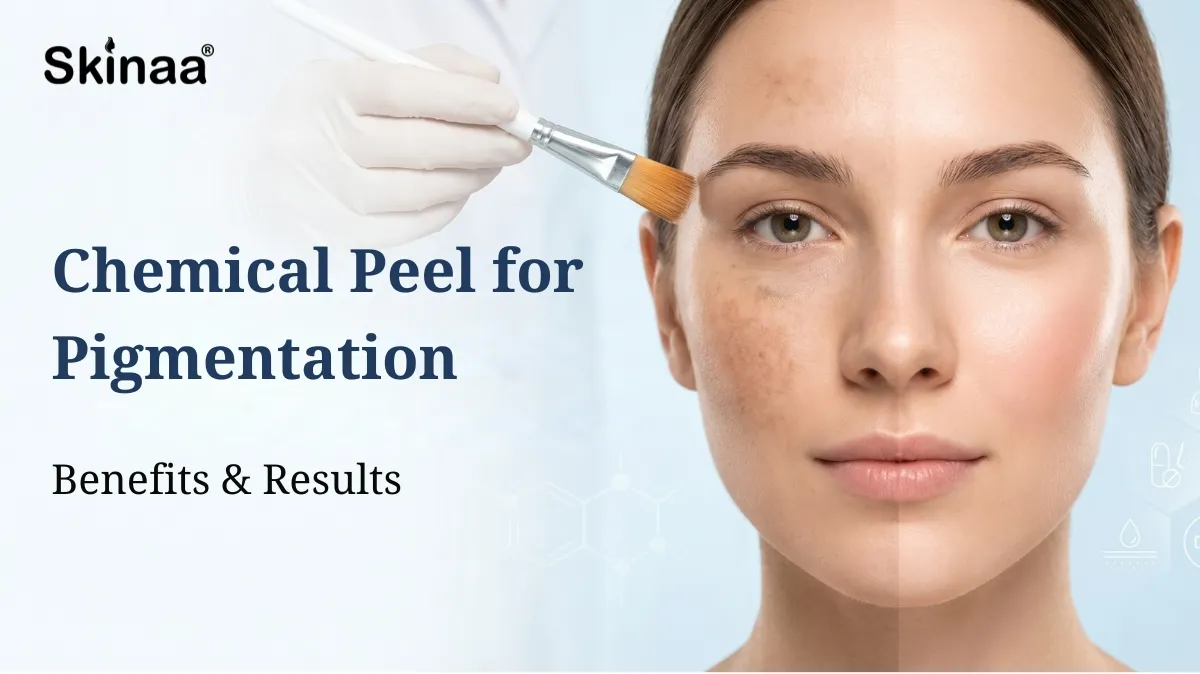
Pigmentation is one of the most common skin concerns, yet one of the most frustrating to treat. Many people try multiple creams, home remedies, and even expensive skincare routines, but the results are often temporary.
A very common concern patients share is:
“My pigmentation lightens for some time, but it always comes back.”
This happens because most treatments only work on the surface, while pigmentation often exists at deeper levels of the skin.
This is where chemical peels come in. They are one of the most effective and dermatologist-recommended treatments for pigmentation when done correctly.
At Skinaa Clinic, chemical peels are used as part of a structured, medical approach to treat pigmentation safely while delivering visible and long-lasting results.
What is a Chemical Peel? (Clinical Understanding)
A chemical peel is a dermatological procedure where a specially formulated solution is applied to the skin to exfoliate the outer layers.
This controlled exfoliation helps remove damaged skin cells and stimulates the regeneration of new, healthier skin.
Unlike regular scrubs or home exfoliation, chemical peels work at a deeper level and are designed to target specific skin concerns like pigmentation, acne, and uneven texture.
How Chemical Peels Help in Pigmentation
Pigmentation occurs due to excess melanin accumulation in the skin. Chemical peels help by gradually removing the layers where pigment is concentrated.
As the skin renews itself, pigmentation becomes lighter and the overall skin tone appears more even.
Additionally, chemical peels improve the penetration of active ingredients, making the overall treatment more effective.
Types of Chemical Peels Used for Pigmentation
Different types of peels are used depending on the severity and type of pigmentation.
Superficial peels are commonly used for mild pigmentation and work gently on the outermost layer of the skin. These are safe for repeated sessions and involve minimal downtime.
Medium-depth peels are used for more stubborn pigmentation and target slightly deeper layers, providing more noticeable results.
At Skinaa Clinic, the peel selection is always personalized based on skin type and condition to ensure both safety and effectiveness.
Benefits of Chemical Peels for Pigmentation
Chemical peels provide gradual and controlled improvement, which is essential for pigmentation treatment.
They help in:
- Reducing dark spots
- Improving skin tone and brightness
- Enhancing overall skin texture
Over time, the skin appears brighter, smoother, and more even.
Another advantage is that chemical peels can be combined with other dermatological treatments, making them a versatile and effective option.
What Results Can You Expect?
Results from chemical peels are progressive rather than instant.
With consistent sessions, patients typically notice:
- Reduction in pigmentation intensity
- Improved skin brightness
- Smoother skin texture
- More even skin tone
The key factor behind good results is consistency and following a dermatologist-recommended treatment plan.
Why Chemical Peels Work Better Than Home Remedies
Home remedies and over-the-counter products often provide limited results because they do not penetrate deeply into the skin.
Chemical peels, on the other hand, are designed to work at a clinical level. They remove damaged layers of skin and promote skin regeneration, leading to long-lasting improvement.
Real Problem-Solving Insight
Many patients expect pigmentation to improve quickly after one or two sessions. When this does not happen, they assume the treatment is not working.
In reality, pigmentation develops gradually, and its treatment also requires time and consistency.
Another common mistake is stopping treatment early, which leads to recurrence.
A structured approach with proper follow-up is essential for achieving stable and long-term results.
Role of Skincare Along with Chemical Peels
Chemical peels alone cannot deliver lasting results without proper skincare.
Daily use of sunscreen is essential, as it prevents further darkening and recurrence of pigmentation.
A gentle cleanser helps maintain skin balance, while a good moisturizer supports the skin barrier.
Dermatologist-recommended products further enhance treatment outcomes and help maintain results.
Combination Treatments for Better Results
In many cases, chemical peels are combined with other treatments for enhanced outcomes.
Laser treatments may be used for deeper pigmentation, while bio-stimulating procedures like PRP support skin regeneration and improve overall skin quality.
This combination approach ensures that pigmentation is treated at multiple levels, leading to better and more stable results.
Why Professional Supervision Matters
Chemical peels may seem simple, but incorrect selection or application can lead to irritation, sensitivity, or worsening of pigmentation.
This is why professional supervision is important.
At Skinaa Clinic, each treatment is performed after proper skin evaluation, ensuring that the peel strength, type, and frequency are tailored to individual needs.
This approach helps achieve visible improvement while maintaining skin safety.
When Should You Consider Chemical Peels
If pigmentation is persistent, uneven skin tone is visible, or dark spots are not improving with regular products, chemical peels can be an effective option.
Early treatment helps prevent pigmentation from becoming deeper and more difficult to treat.
Conclusion
Chemical peels are one of the most effective clinical treatments for pigmentation when used correctly.
With the right approach, they can significantly improve skin tone, dark spots, and overall skin quality.
The key to success lies in proper diagnosis, expert supervision, and consistent care.
If your pigmentation is not improving despite trying multiple products, it may be time to switch to a more structured and dermatologist-guided approach. At Skinaa Clinic, treatment plans are designed to address the root cause of pigmentation and deliver visible, long-lasting results.
FAQs
1. Are chemical peels safe for pigmentation?
Yes, when performed by dermatologists, they are safe and effective.
2. How many sessions are required?
Multiple sessions are usually needed for best results.
3. Do chemical peels remove pigmentation permanently?
They significantly reduce pigmentation, but maintenance is required.
4. Is there any downtime?
Superficial peels have minimal downtime.
5. Can chemical peels be combined with other treatments?
Yes, they are often combined for better results.